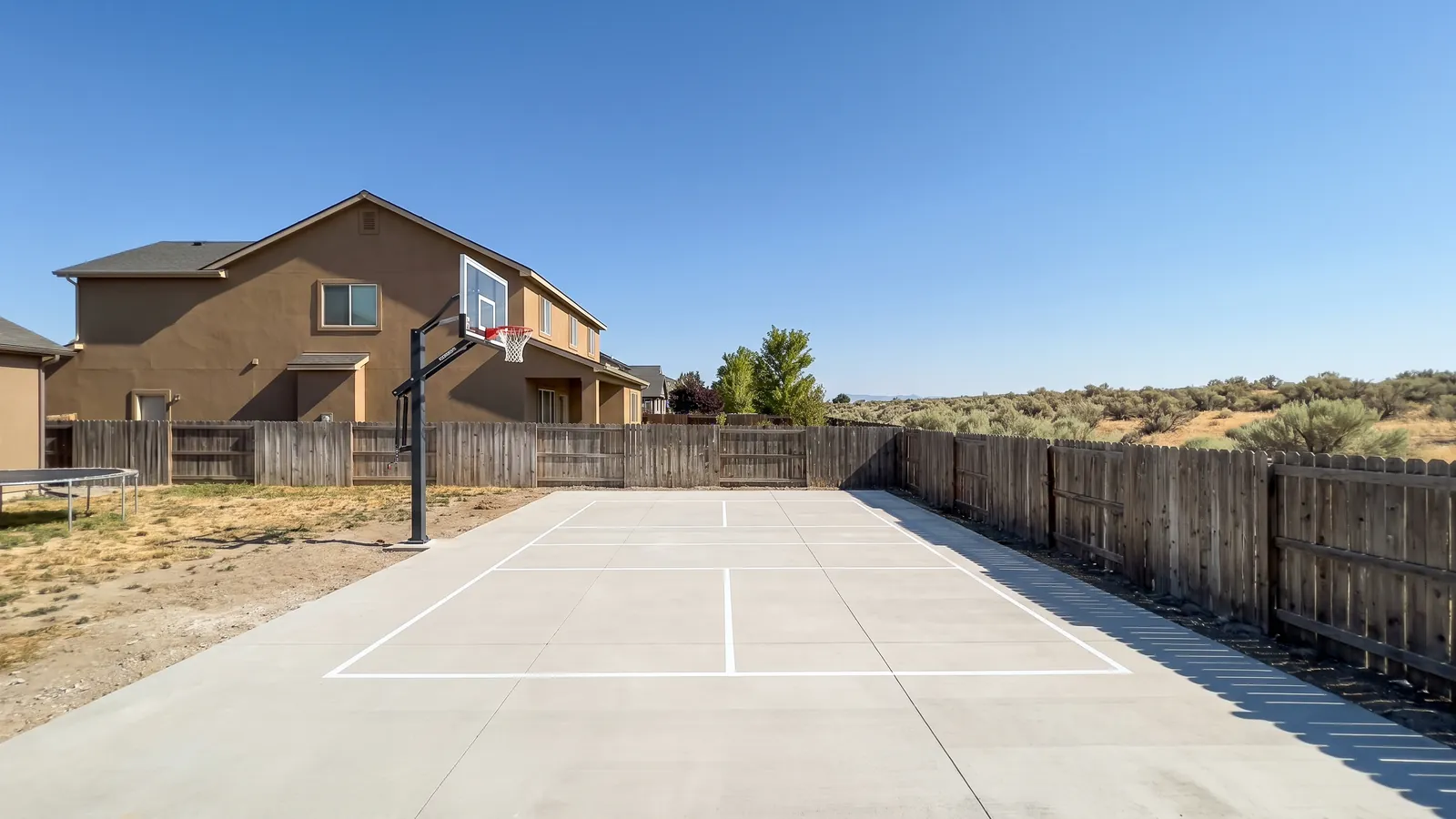
Most Meridian sport courts are one of two sizes. A half-court for basketball is usually about 30 by 30 feet, sometimes 20 by 25 on a tighter lot. A pickleball court is 20 by 44 feet of playing lines, and the recommended overall slab is about 30 by 60 so players have room behind the baseline. A slab that size is a real piece of the yard. It needs a level pad, a compacted gravel base, reinforcement throughout and a single, steady slope of about 1 percent across the court so rain and sprinkler water run off one side. A court that is crowned or dished holds puddles, and puddles freeze into ice on a Meridian winter morning.
Joints are the trade-off. Any slab that large needs control joints, and a joint that runs through the key or along a pickleball kitchen line is something players feel. We lay joints out along court lines where possible, use a thicker, more heavily reinforced slab to stretch the spacing, and saw-cut the same day. The court then cures for about four weeks before the acrylic surface goes on, because a coating applied over green concrete blisters. We coordinate the surfacing with a court-coating specialist and recommend lighter colors. Boise averages about 55 days a year at 90 degrees or hotter, and a dark court gets uncomfortable to play on.
Hoops and net posts need their own footings below the 24-inch frost line, usually as deep as the hoop maker specifies, so the pole doesn't lean after a winter. A court near the property line is still flatwork, but a fence around it taller than 6 feet needs a City permit, lights need an electrical permit, and many HOAs have rules on both. We confirm those at the estimate.
What's included
Laid out for play
Half-court, full pickleball or a combined layout, with the slab sized for the run-out behind the lines.
One slope, no puddles
About 1 percent across the court so water leaves one side and doesn't sit or freeze on it.
Joints on the lines
Control joints aligned with court lines where possible and saw-cut the same day.
Ready for coating
A smooth, uniform finish and a full cure before the acrylic surface goes on.
Hoop and post footings
Sleeves and footings below frost depth so the pole stays plumb after winter.
Permits checked
Fence height, lighting and HOA rules confirmed before we pour.
Sport court costs in Meridian, ID
| Job | Typical price | Notes |
|---|---|---|
| Basketball half-court slab, 30×30 | $8,600 – $12,600 | 900 sq ft, reinforced |
| Pickleball court slab, 30×60 | $16,000 – $23,500 | 1,800 sq ft, reinforced |
| Per square foot, court-grade slab | $9 – $13 | Base, steel, finish, joints |
| Hoop or net-post footing and sleeve | $400 – $900 | Below frost depth |
| Acrylic court surfacing and lines | $3 – $6 per sq ft | By a court-coating specialist after cure |
| Grading a sloped yard for a court | Quoted after a site visit | Cut, fill and compaction |
These are 2026 Treasure Valley ranges to help you budget. Your written price is itemized (removal, base, mix, thickness, reinforcement, finish, joints, sealer and any permit) and good for 30 days.
Recent work
Questions we get about sport courts
How long before we can play on it?
You can shoot baskets on bare concrete after about a week. The acrylic surface should wait about four weeks, until the slab has cured, or it may blister.
Why does the court slope?
A perfectly flat slab holds water. About 1 percent of slope in one direction drains it without being noticeable when you play.
Can you avoid joints in the court?
Not entirely on a slab this size. We put them along court lines where we can and use extra reinforcement to space them out. Coating fills them so the ball bounces true.
Do I need a permit for a sport court?
The slab is flatwork and usually needs no City building permit. A fence over 6 feet, lights or a structure does, and your HOA may have rules. We check before we pour.
How deep does the hoop footing go?
Below the 24-inch frost line at a minimum, and to the depth the hoop manufacturer specifies, which is often 36 to 48 inches for an in-ground system.
Can a court double as RV parking?
We can build it thick enough, but jacks and tires mark the coating. If you need both, we usually pour an RV pad next to the court instead.