Why Meridian concrete scales, and how to stop it
The Boise airport records about 108 nights a year at or below freezing. On most of them the afternoon thaws again. That cycle, plus the deicer that drips off your car, is what flakes the surface off a driveway.
The weather, in numbers
NOAA's 1991–2020 normals for the Boise Air Terminal, about ten miles east of Meridian, show 108.2 days a year with a low at or below 32°F but only 16.3 days when the high stays at or below freezing. Subtracting gives about 92 days a year when the surface freezes overnight and thaws by afternoon. That's our calculation, not an official count, and it varies by year: the daily records show anywhere from 56 such days (2014) to 109 (2020 and 2022). Most of those days fall from November through March. Meridian's own code rates the weathering exposure as severe.
What freeze-thaw does
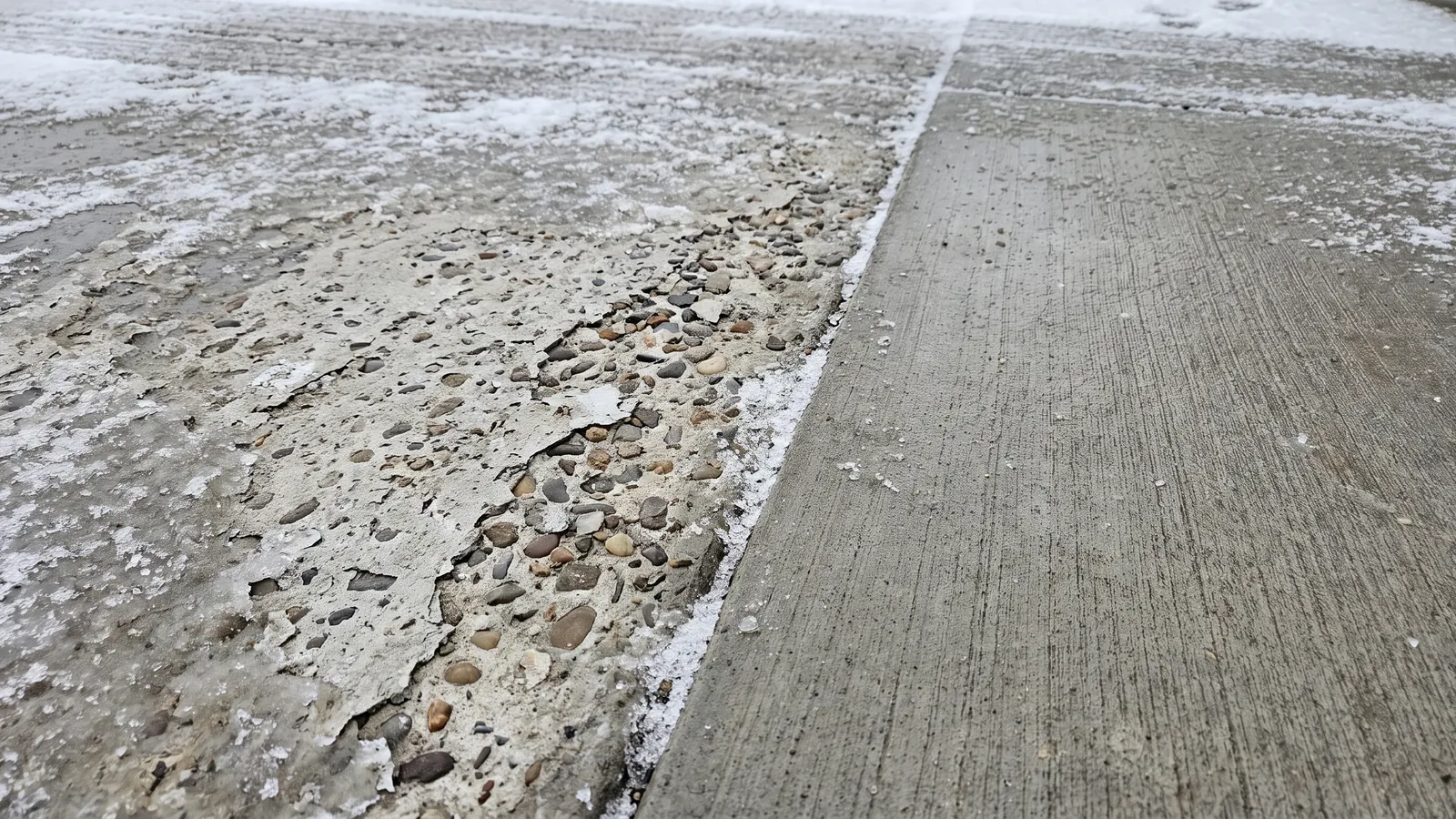
Concrete is porous. Water soaks into the top of the slab, freezes and expands by about 9 percent, then thaws and soaks in deeper. Repeat that dozens of times a winter and the top layer of paste, the part that was troweled smooth, starts to flake off in patches. That's scaling. It's worst where the slab stays wettest: at the garage where snow melts off the car, along the edge where sprinklers soaked it into fall, and at the approach where plowed slush piles up.
Where the deicer comes from
ACHD uses magnesium chloride, salt and sand on its roads, and applies liquid magnesium chloride as an anti-icer on priority routes before freezing weather. Cars carry it home and it drips off at the garage and the approach. The National Ready Mixed Concrete Association's guidance on scaling is blunt: avoid deicing chemicals in the first winter, and never use ammonium sulfate, ammonium nitrate or magnesium-based salts as a deicer. You can't stop the road crews, but you can rinse the garage apron after a slushy commute and avoid adding magnesium-based ice melt yourself.
What prevents it: air, mix and finishing
The fix starts at the plant. Air-entraining admixture puts billions of microscopic bubbles in the paste, giving freezing water room to expand. The American Cement Association puts typical air content between 4 and 7 percent, and the NRMCA recommends about 6 percent for exterior slabs with ¾- or 1-inch aggregate. For slabs that stay moist and see deicers, the NRMCA recommends ordering 4,000 psi concrete. The concrete industry's code classifies a slab with frequent exposure to water and deicers as its most severe freeze-thaw class, F3.
The rest happens on site. Extra water added to make the concrete easier to place weakens the surface, so we place at a normal slump rather than "soupy." Finishing while bleed water is on the surface traps a weak layer that scales first, so we wait. A broom finish, not a steel-troweled one, leaves a better surface for outdoor slabs. Then a curing compound the first day, so the surface doesn't dry out before it gains strength, and a breathable silane or siloxane sealer before the first winter.
Winter care for your concrete
- First winter: no deicers. Use sand for traction and shovel promptly.
- After that: a little plain rock salt (sodium chloride) on a sealed, air-entrained slab is the least harmful choice. Use as little as works.
- Never: magnesium chloride, ammonium nitrate or ammonium sulfate products, or fertilizer as an ice melt.
- Rinse: hose off the garage apron and approach on a mild day to wash away road deicer.
- Reseal: every few years with a penetrating silane or siloxane sealer.
- Sprinklers: aim heads away from slab edges, and blow out the system before the first hard freeze.
When scaling has already started
Shallow scaling on a sound slab can be ground and resurfaced with a bonded polymer overlay, then sealed. If the scaling has reached the stone, or the slab is also cracked and settled, replacement is usually the better money. See repair and leveling for prices.
Common questions
Is scaling covered by warranty?
It depends on the contract and the cause. Scaling from a poor mix or finishing usually shows up in the first winter or two. Scaling after years of magnesium chloride is wear. We write our mix and finishing specs on the quote.
Does sealing really help?
Yes. A penetrating sealer keeps water and salt out of the surface pores without trapping moisture. It doesn't fix a bad mix, but it slows scaling on a good one.
Can I tell whether my concrete has air in it?
Not by looking. The air content is measured on the truck when the concrete is placed. Ask your contractor for the mix ticket; ours lists it.
Is rock salt safe for concrete?
On a sealed, air-entrained slab that's past its first winter, used sparingly, plain rock salt is the least harmful common deicer. It still corrodes steel and harms plants, so use as little as possible.
Related: Concrete driveways · Repair and leveling · Walkways and steps · When to pour