The short answer
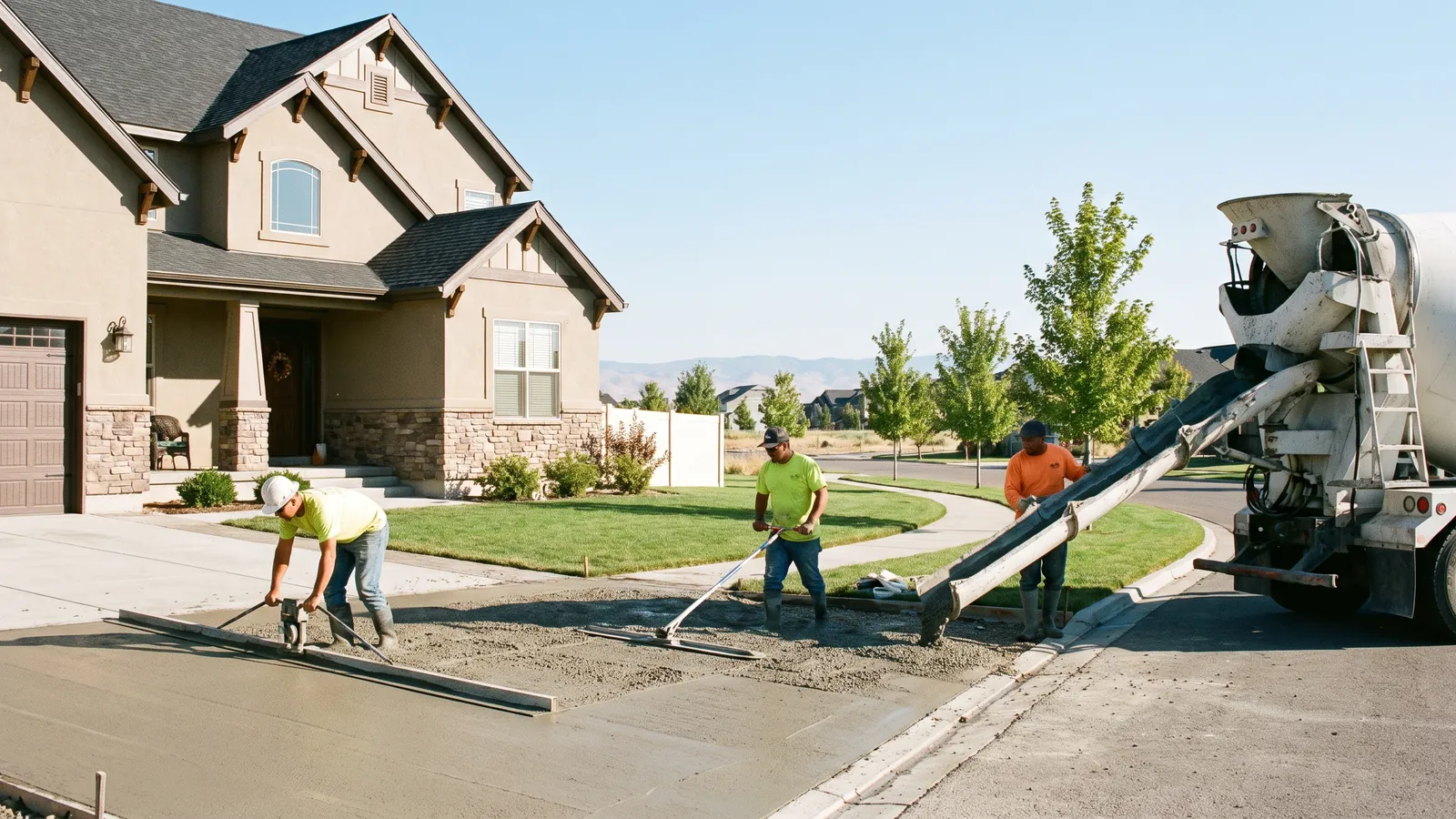
A reinforced, broom-finish concrete driveway in the Meridian area runs about $8 to $12 per square foot installed in 2026, on a compacted gravel base with air-entrained concrete. A typical two-car driveway of 24 by 40 feet (960 square feet) comes to roughly $7,700 to $11,500. A single-car 12 by 40 (480 square feet) is about $3,850 to $5,750. Breaking out and hauling the old driveway adds $1.50 to $2.50 per square foot, so a full replacement of a two-car builder driveway usually lands between $9,100 and $14,000. Anything in ACHD's right-of-way, such as the approach, curb cut or sidewalk crossing, is priced on its own line because it has its own permit and bonding requirements.
Prices by job
| Job | Typical price | Notes |
|---|---|---|
| Broom-finish driveway, 4 in, reinforced | $8 – $12 per sq ft | On at least 4 in of compacted gravel |
| Two-car driveway, 24×40 | $7,700 – $11,500 | 960 sq ft, new or after tear-out |
| Single-car driveway, 12×40 | $3,850 – $5,750 | 480 sq ft |
| Tear-out and haul of the old driveway | $1.50 – $2.50 per sq ft | Recycled where accepted |
| Five- or six-inch section for a truck, trailer or RV | + $1.50 – $2.50 per sq ft | Where heavy loads park |
| Widening or an extra parking strip | $9 – $13 per sq ft | Small pours cost more per foot |
| Extra base where the ground is soft | + $1 – $2 per sq ft | Found with a test hole |
| Approach replacement in ACHD right-of-way | $2,400 – $5,000 | Plus ACHD permit costs |
| Stamped or decorative upgrade | $14 – $20 per sq ft total | Pattern and color |
| Penetrating sealer after cure | $0.90 – $1.60 per sq ft | Before the first winter |
| Foam lifting instead (sound slab, sunk at the garage) | $650 – $2,100 | Often a fraction of replacement |
What moves the number
- Size and shape. Big, simple rectangles are cheapest per foot. Curves, flares at the street and small add-on pours cost more per foot because the forming and finishing take longer.
- Tear-out. A thin builder driveway breaks out quickly. A thick slab with rebar, or one that has been overlaid, takes longer and weighs more to haul.
- The base. Meridian's code requires at least four inches of compacted gravel under street-yard driveways and parking. Where the old slab left voids, or the silt is soft from years of sprinkler water, we dig out and add more.
- Thickness and steel. Four inches for cars, five to six where a truck, trailer or RV parks, with rebar or wire on chairs. That's not where to save money.
- The mix. Air-entrained concrete around 4,000 psi costs a little more than a basic mix, and it's what keeps the surface from scaling through about 92 freeze-thaw days a year.
- The approach. If the approach is sound, we tie into it. If it's cracked or the curb cut is changing, it's ACHD right-of-way work with its own permit and a bonded contractor.
- Access and season. A truck that can chute straight into the forms is the cheap case. A pump adds cost. Cold-weather pours need blankets and a heated mix, and summer pours start at first light.
- Finish. Broom is the base price. A smooth border, exposed aggregate, color or a stamped pattern adds per foot.
What a real quote includes
A written, itemized price good for 30 days. It should list the measured square footage, the tear-out and haul, the base depth, the thickness and reinforcement, the mix (strength and air content), the joint layout, the finish, curing and sealing, the approach and its ACHD permit if any, and your HOA submittal if one is needed. For any residential contract over $2,000, Idaho Code 45-525 requires the contractor to give you a disclosure statement before you sign. It covers lien waivers, proof of general liability and workers' comp, extended title insurance and your right to require a surety bond. The contractor's Idaho registration number should be on the contract. If a quote is just a per-foot number on a business card, the base and the approach are guesses.
Common questions
Why is the approach priced separately?
It's in ACHD's right-of-way, under ACHD's permit and specifications, and it has to be done by a contractor with a $25,000 bond and $500,000 in liability insurance. Listing it separately shows you exactly what it costs.
Is reinforcement really necessary?
Steel doesn't stop cracks. It holds them tight and keeps the panels level when the ground moves or a heavy vehicle parks. On a driveway it's inexpensive insurance.
Can I save money by keeping the old approach?
If it's sound and sits at the right height, yes. We saw-cut at the property line and tie in with a joint. If it's cracked or scaled, replacing it with the driveway saves a second mobilization.
Do you charge for estimates?
No. An estimator measures the job, digs a test hole if needed and leaves a written price good for 30 days.
Related: Concrete driveways · Builder driveway replacement · Approaches and sidewalks · Financing