What's under the lawn
The USDA's soil survey for Ada County maps a handful of silt loams across Meridian. In a box covering the city, by our calculation from the survey data, Purdam silt loam covers about 36 percent, Elijah silt loam about 16 percent, Aquic Torriorthents about 11 percent, Paulmyers silt loam about 9 percent and Pipeline silt loam about 7 percent, with smaller areas of Power and Colthorp. These soils formed from wind-blown silt and old river deposits, and most of them are well drained at the surface.
The duripan
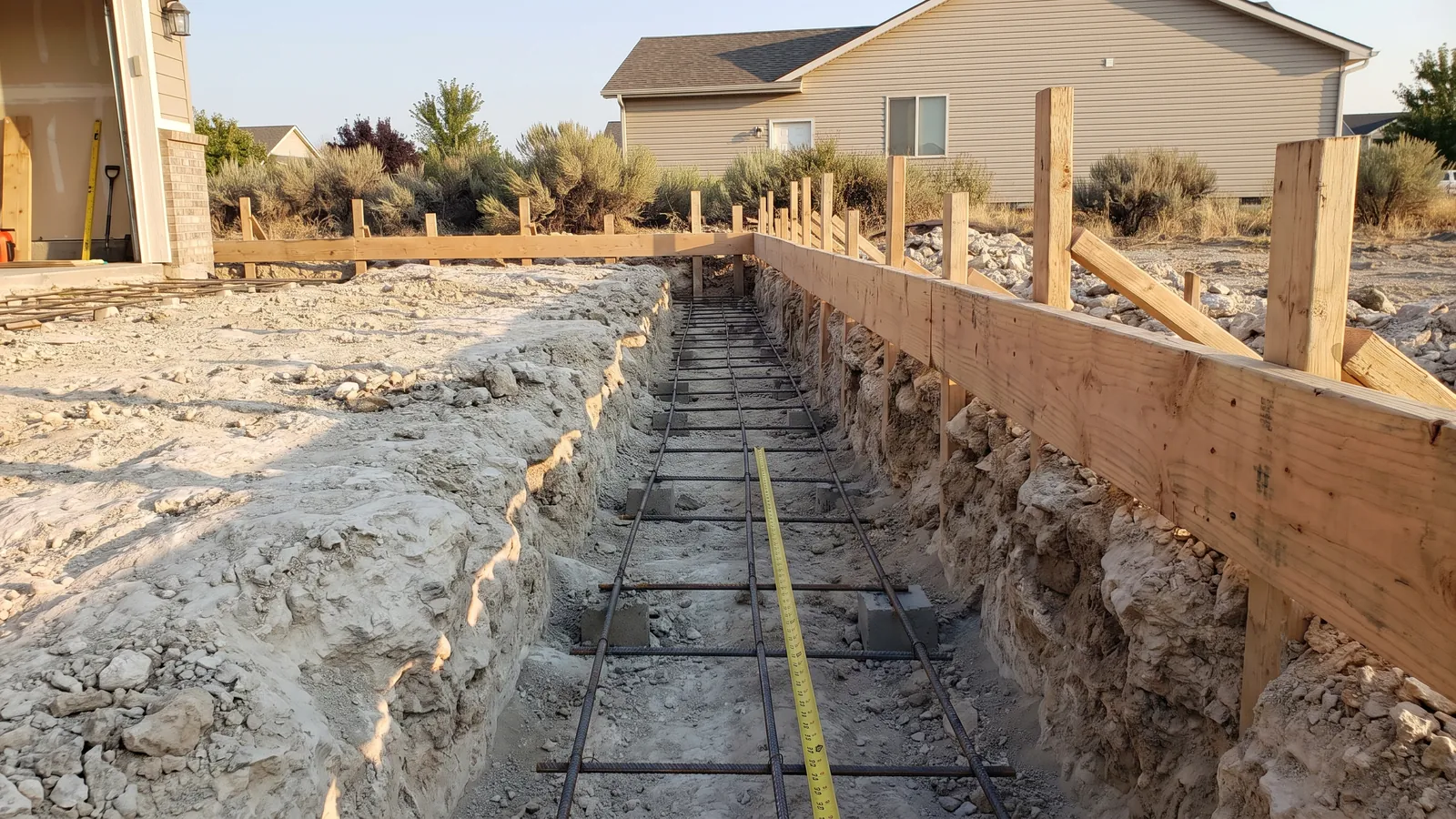
What makes Meridian's ground unusual is the hardpan. A duripan is a soil layer cemented by silica, often with lime, hard enough that it rings when a shovel hits it. The survey puts it at about 24 inches in Purdam soil, where the official description calls it strongly cemented, and about 31 inches in Elijah soil, described as very strongly cemented with a laminar cap. In Pipeline and Colthorp soils it's about 19 inches, and Colthorp has bedrock at about 28 inches. Power silt loam, by contrast, is very deep with no restrictive layer. People often call the hardpan "caliche," though soil scientists reserve that term for lime-cemented layers.
What it means for footings
Meridian's frost line is 24 inches, so a footing has to bear at least that deep. Across much of the city that's exactly where the duripan starts. The hardpan itself is excellent bearing, but cutting a trench through it takes a breaker or a rock bucket, and that time belongs on the quote. We dig a test hole at the estimate for any footing job, whether a shop, a garage, a patio cover or a sport-court hoop. Where the hardpan is high, the footing is chipped down to depth or, for larger structures, adjusted with the engineer.
What it means for slabs
For flatwork, the hardpan matters less directly than the water above it. Water that soaks down from lawn irrigation can perch on top of the duripan and stay in the silt just under the slab. Meridian requires underground pressurized irrigation for every lot in a new subdivision, and most lawns are watered generously all summer. A sprinkler head spraying the edge of a driveway, or a slow leak in a line beside a walk, softens the silt and washes fine material out from under the slab. That, more than the soil itself, is why panels tip and sink. The cure is a compacted gravel base (Meridian requires at least 4 inches under street-yard driveways and parking), sprinkler heads aimed away from concrete, and grading that moves water off and away from slabs.
Shrink-swell, wet spots and corrosion
The survey rates the major Meridian soils as moderate for shrink-swell, with a linear extensibility of about 4.5 to 5.4 percent. That's enough to matter for long unreinforced slabs but far milder than true expansive clays. A few soils, mainly Paulmyers and the Aquic Torriorthents along drainages, have water tables within about 45 and 27 inches, and those are the spots where footing trenches fill and slabs need deeper bases. The survey also rates Purdam and Paulmyers high for corrosion of steel, which is why rebar in footings gets full concrete cover.
Nearby cities
The ground changes as you leave Meridian. Kuna sits on Colthorp soils with hardpan around 19 inches and bedrock not far below. Middleton's river-bottom Moulton soils have water around 27 inches. Caldwell's most common soil, Power silt loam, has no hardpan at all. See our service area pages for each.
Common questions
Is the hardpan a problem for a driveway?
Rarely. A driveway sits on 4 or more inches of gravel near the surface, well above the hardpan. It matters for footings and for drainage, not for ordinary flatwork.
Why does my slab sink if the soil is well drained?
Usually water from irrigation. A leaking line or a sprinkler soaking the slab edge softens the silt and washes it out from underneath. Fix the water and lift the slab.
Do I need an engineer because of the hardpan?
Not for most residential work. For an addition, an ADU or a large shop, the designer or engineer accounts for it in the footing design, and we confirm depths with test holes.
Is Meridian soil expansive?
Moderately. The survey's shrink-swell numbers are in the moderate range, not the high range of true expansive clays. Reinforcement and joints handle it.
Related: Foundations and footings · Shed and shop slabs · Repair and leveling · Freeze-thaw and deicers